
Your bag is empty
Don't miss out on great deals! Start shopping or Sign in to view products added.
Shop What's New Sign in£67.98 Save:£18.00(20%)
Available in stock
| ISBN-10: | 0387989900 |
|---|---|
| ISBN-13: | 978-0387989907 |
| Edition: | 2001st |
| Publisher: | Springer |
| Publication date: | 23 Oct. 2000 |
| Language: | English |
| Dimensions: | 16.28 x 2.62 x 24.36 cm |
| Print length: | 458 pages |
 Invincible Compendium Volume 2 (INVINCIBLE COMPENDIUM TP)
£35.41
 The New GCSE Arabic Companion (9-1)
£23.75
 Of Mice and Men (New Longman Literature - Plain Edition)
£2.92
 The Red Rising Series Collection 5 Books Set By Pierce Brown (Red Rising, Golden Son, Morning Star, Iron Gold, Dark Age)
£18.67
 Dead Girls Don't Talk - Amazon Exclusive Edition: A YA thriller about a murdered girl, but if you flip over the book you can read from the killer's POV.
£12.54
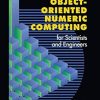
This book is intended to be an easy, concise, but rather complete, introduc the ISO/ANSI C++ programming language with special empha tion to sis on object-oriented numeric computation for students and professionals in science and engineering. The description of the language is platform independent. Thus it applies to different operating systems such as UNIX, Linux, MacOS, Windows, and DOS, as long as a standard C++ compiler is equipped. The prerequisite of this book is elementary knowledge of cal culus and linear algebra. However, this prerequisite is hardly necessary if this book is going to be used as a textbook for teaching C++ and all the sections on numeric methods are skipped. Programming experience in an other language such as FORTRAN, C, Ada, Pascal, Maple, or Matlab will certainly help, but is not presumed. All C++ features are introduced in an easy way through concepts such as functions, complex numbers, vectors, matrices, and integrals, which are familiar to every student and professional in science and engineering. In the final chapter, advanced features that are not found in FORTRAN, C, Ada, or Matlab, are illustrated in the context of iterative algorithms for linear systems such as the preconditioned conjugate gradient (CG) method and generalized minimum residual (GMRES) method. Knowledge of CG, GMRES, and preconditioning techniques is not presumed and they are ex plained in detail at the algorithmic level. – ASIN: 0387989900 | ISBN13: 9780387989907 | ISBN-13: 978-0387989907
You must be logged in to post a review.


Reviews
There are no reviews yet.