
Your bag is empty
Don't miss out on great deals! Start shopping or Sign in to view products added.
Shop What's New Sign in£3.60 Save:£1.00(19%)
Available in stock
| Part of series: | Occasional Publications S. |
|---|---|
| Print length: | 8 pages |
| Language: | English |
| Publisher: | Field Studies Council |
| Publication date: | 1 July 2000 |
| Dimensions: | 24.5 x 0.4 x 17.7 cm |
| ISBN-10: | 1851538682 |
| ISBN-13: | 978-1851538683 |
 Invincible Compendium Volume 2 (INVINCIBLE COMPENDIUM TP)
£35.41
 The New GCSE Arabic Companion (9-1)
£23.75
 Of Mice and Men (New Longman Literature - Plain Edition)
£2.92
 The Red Rising Series Collection 5 Books Set By Pierce Brown (Red Rising, Golden Son, Morning Star, Iron Gold, Dark Age)
£18.67
 Dead Girls Don't Talk - Amazon Exclusive Edition: A YA thriller about a murdered girl, but if you flip over the book you can read from the killer's POV.
£12.54
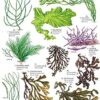
Identification guide to 36 common species of seaweeds Arranged into three groups: green, brown and red Accompanying key highlights important features to look for Designed to be used outside: lightweight, rucksack-sized, splash-proof WildID Seaweeds guide features 36 common species of seaweeds. It will help you to put a name to the green, brown and red seaweeds you see. Text on the reverse side includes a full seaweed identification key that can be used with living seaweeds on the seashore. Seaweeds are the dominant plant-like organisms of rocky shores. They can also occur on sandy and muddy shores, particularly where there are wooden or concrete structures. Seaweeds are algae, not plants. Unlike plants, seaweeds do not have true roots, stems or leaves. Instead the holdfast, stipe and frond perform the function of these tissues. Like most plants, seaweeds use the sun’s energy to make sugars through photosynthesis. They possess the green pigment chlorophyll, and some also possess extra accessory pigments of different colours. Seaweed-covered shores are particularly interesting to study because there is often a great deal of habitat variation within a relatively small space. It is worth comparing the diversity and abundance of seaweeds on two or more shores, such as different faces of the same coastal headland. The biggest problem for most seaweeds on seashores is that of water loss during the time they are out of water. Another major problem for seaweeds is that of exposure to physical damage from wave action. Exposed shores face out into the open sea and into the prevailing wind. Therefore they are subject to more wave action than sheltered shores. Most seaweeds need something to stick on to, so more will be found on rocky sheltered shores rather than on sandy or muddy substrates. – ASIN: 1851538682 | ISBN13: 9781851538683 | ISBN-13: 978-1851538683
You must be logged in to post a review.




Reviews
There are no reviews yet.