
Your bag is empty
Don't miss out on great deals! Start shopping or Sign in to view products added.
Shop What's New Sign in£21.08 Save:£7.00(25%)
Available in stock
| Print length: | 576 pages |
|---|---|
| Language: | English |
| Publisher: | Johns Hopkins University Press |
| Publication date: | 5 Dec. 2023 |
| Dimensions: | 15.56 x 4.37 x 23.5 cm |
| ISBN-10: | 1421446642 |
| ISBN-13: | 978-1421446646 |
 Invincible Compendium Volume 2 (INVINCIBLE COMPENDIUM TP)
£35.41
 The New GCSE Arabic Companion (9-1)
£23.75
 Of Mice and Men (New Longman Literature - Plain Edition)
£2.92
 The Red Rising Series Collection 5 Books Set By Pierce Brown (Red Rising, Golden Son, Morning Star, Iron Gold, Dark Age)
£18.67
 Dead Girls Don't Talk - Amazon Exclusive Edition: A YA thriller about a murdered girl, but if you flip over the book you can read from the killer's POV.
£12.54
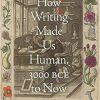
A sweeping history of how writing has preserved cultural practices, traditions, and knowledge throughout human history. In How Writing Made Us Human, 3000 BCE to Now , Walter Stephens condenses the massive history of the written word into an accessible, engaging narrative. The history of writing is not merely a record of technical innovations―from hieroglyphics to computers―but something far richer: a chronicle of emotional engagement with written culture whose long arc intimates why the humanities are crucial to society. For five millennia, myths and legends provided fascinating explanations for the origins and uses of writing. These stories overflowed with enthusiasm about fabled personalities (both human and divine) and their adventures with capturing speech and preserving memory. Stories recounted how and why an ancient Sumerian king, a contemporary of Gilgamesh, invented the cuneiform writing system―or alternatively, how the earliest Mesopotamians learned everything from a hybrid man-fish. For centuries, Jews and Christians debated whether Moses or God first wrote the Ten Commandments. Throughout history, some myths of writing were literary fictions. Plato’s tale of Atlantis supposedly emerged from a vast Egyptian archive of world history. Dante’s vision of God as one infinite book inspired Borges’s fantasy of the cosmos as a limitless library, while the nineteenth century bequeathed Mary Shelley’s apocalyptic tale of a world left with innumerable books but only one surviving reader. Stephens presents a comprehensive history of the written word and demonstrates how writing has preserved and shaped human life since the Bronze Age. These stories, their creators, and their preservation have inspired wonder and an endless appetite for historical revelation. – ASIN: 1421446642 | ISBN13: 9781421446646 | ISBN-13: 978-1421446646
You must be logged in to post a review.


Reviews
There are no reviews yet.